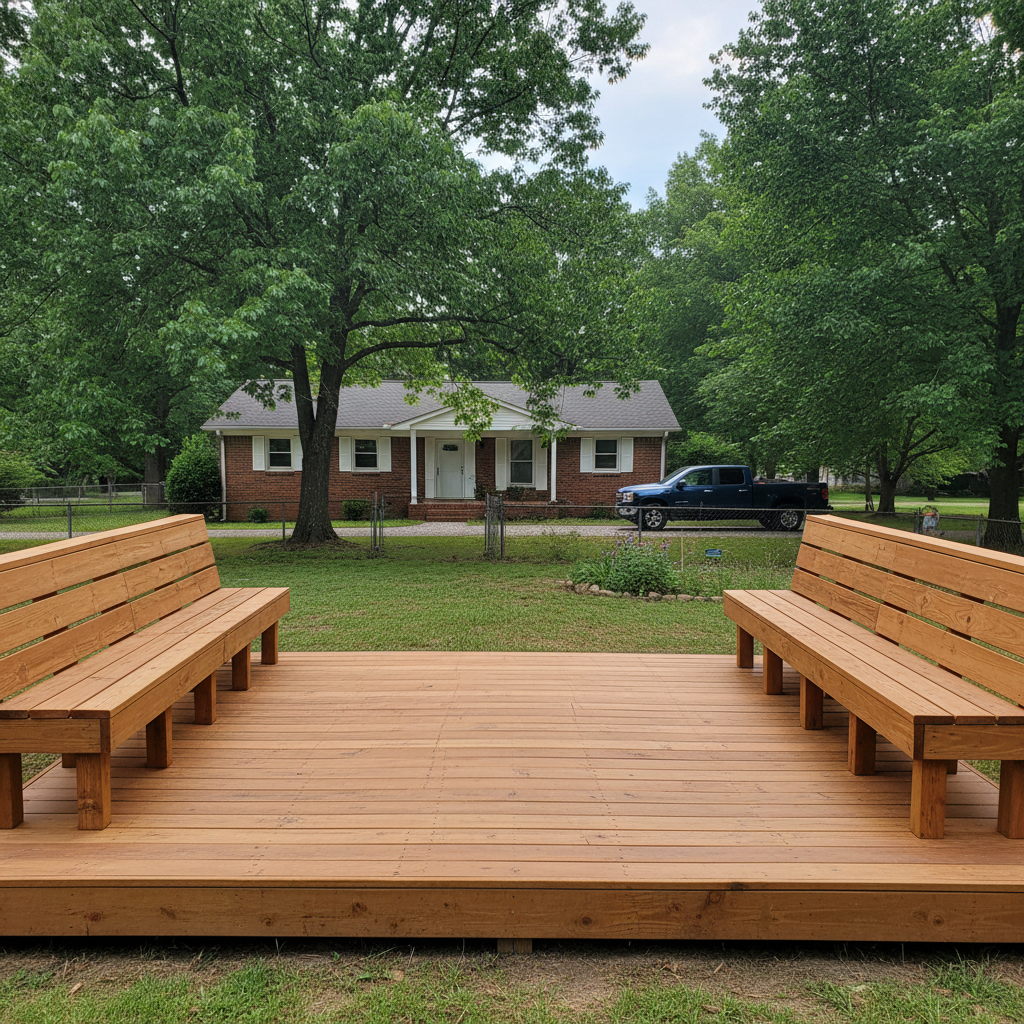
Foley gets more deck builders than most towns its size, partly because the building boom out toward OWA and the Beach Express never really slowed down, and partly because a deck is the kind of job that looks simple enough for anyone with a circular saw and a truck. Some of that work is fine. A lot of it fails in year three, right around the time the lag bolts holding the ledger board start pulling away from the rim joist because nobody flashed it. Here's what actually separates a builder worth hiring from one you'll be calling back about.
Start with what's under the deck, not what's on top of it
Baldwin County soil around Foley is mostly sandy loam, which drains fast and that's good, but it also compacts less than clay and doesn't hold a footing the same way. A deck post resting on a concrete paver or a buried 4x4 might look level the day it's built. Give it two rainy seasons and one or two posts will have settled unevenly, and now your deck has a lean nobody notices until the railing feels loose.
A proper footing here means a poured concrete pier, usually 10 to 12 inches in diameter, set below grade with the post base bolted on top, not buried in the dirt where it'll rot. Frost depth isn't the issue in south Alabama the way it is up north, but bearing capacity and drainage still are. If a builder can't tell you how deep they're going and why, that's worth asking twice.
Permits aren't optional, and skipping one shows up later
Most deck work in Foley needs a permit through the city or Baldwin County, depending on whether you're inside the city limits or out in the county. That means an inspector looks at the footings before you pour concrete over them, and again at the framing before the boards go down. A builder who tells you permits are a waste of time and money is telling you they'd rather not have anyone checking their ledger attachment or their joist spacing.
This matters at resale too. An unpermitted deck can hold up a home sale or an insurance claim, and a buyer's inspector in a place like this will notice a deck that was clearly never inspected. If you're in one of the newer subdivisions off County Road 20 with an HOA, there's usually a separate approval step on top of the permit, for things like deck height and how close it can sit to the property line. Ask your builder if they've dealt with your HOA before. If they haven't dealt with any HOA before, that's a different conversation.
The ledger board is where most decks actually fail
If a deck attaches to the house, the ledger board is bolted to the rim joist and has to be flashed so water running off the house doesn't sit behind the board. In a town with Foley's humidity and a hurricane season that runs June through November, that detail is not cosmetic. A ledger without proper flashing will trap moisture against the house framing, and you won't see the rot until the deck starts to pull away or a board goes soft underfoot.
Ask directly: how are you attaching this to my house, and how are you flashing it? A builder who's done this work will answer in one sentence without hesitating. One who free-floats the deck on its own posts instead of attaching to the house at all isn't wrong either, sometimes that's the better call on an older pier-and-beam home, but you want to hear the reasoning, not a shrug.
Material choice changes what you're actually buying
Pressure-treated southern yellow pine is still the standard frame material here and it's a fine choice for the structure even under composite decking on top. For the boards you walk on, pine is cheaper upfront but needs staining or sealing every two to three years in this climate, more often on a deck that gets full sun most of the day. Composite costs more going in, doesn't need sealing, but still needs a frame built correctly underneath it, and not every installer who's comfortable with wood has done composite.
Fasteners matter more here than people think. Salt air off the Gulf and the general humidity will eat standard steel screws and joist hangers over a few years. Stainless steel or hot-dip galvanized hardware costs more per pound but it's the difference between hardware that's still tight in year ten and hardware that's rusted and weeping stains down your deck boards by year four.
What to walk away from
- No written contract with a materials list, a payment schedule, and a timeline. Verbal agreements fall apart when something costs more than planned.
- A quote dramatically lower than two others for the same square footage. Someone's cutting footings, fasteners, or both.
- No mention of a permit, or a builder who says they'll "handle it" without naming who's pulling it or when the inspection happens.
- Railing specs that sound vague. Code here generally wants a 36 to 42 inch railing height and baluster gaps no wider than 4 inches, small enough that a child's head can't pass through. If a builder doesn't know these numbers off the top of their head, they haven't built many railings.
- Cash only, no insurance certificate on request. A roofer falling off your deck frame without workers' comp coverage becomes your problem, not theirs.
Older neighborhoods versus new subdivisions
A deck project in one of the older streets near downtown Foley is a different job than one in a subdivision built in the last ten years. Older lots often have soil that's been disturbed by decades of landscaping, old slabs, or buried debris, and a good builder digs a test hole before committing to footing depth. Newer subdivision lots tend to have more predictable fill and grading, but tighter setback rules and an HOA looking over the plan. Either way, the builder should walk your actual lot before quoting a price, not just measure off a photo or a satellite image.
None of this is complicated once you know what to ask. A deck is a few hundred square feet of framing, footings, and fasteners exposed to sun, rain, and salt air for the next fifteen to twenty years, and the quality of those hidden parts is what decides whether you're sealing boards on a Saturday or replacing the whole thing. If you want someone to walk your lot and talk through footings, flashing, and materials before you sign anything, that's the conversation we have on every job at Radius Deck Co.